Chicago is proud to be a welcoming city, and the 40th Ward is proud to be a welcoming ward. Our office is and will remain a safe haven for those who are undocumented, and we will continue to work together to ensure that our city treats immigrant Chicagoans as exactly what they are: our neighbors.
Did you know? Ald. Vasquez is the Chairperson of the City of Chicago Committee for Immigrant and Refugee Rights (CIRR). Find upcoming events for immigrants, refugees, and new arrivals on our Community Engagement page (coming soon!). Subscribe to the CIRR newsletter for updates.
Immigration and human rights
Know Your Rights, encounters with law enforcement, workshops
Everyone in the United States, including undocumented immigrants, has rights under the U.S. Constitution. If you encounter an immigration or law enforcement officer, you have to the right to:
- Remain silent and not answer questions;
- Contact an attorney immediately, if you are detained*;
- Refuse to sign anything without advice from an attorney.
* You can find a for-cost, licensed immigration attorney through American Immigration Lawyers Association (AILA).
Encounters with police officers or immigration agents
If you encounter an Immigration and Customs Enforcement (ICE) Officer, keep in mind the following guidance from the Illinois Attorney General’s Office:
- If ICE stops you on the street, you are NOT required to show identification or answer questions.
- ICE can enter and search public areas of your workplace without a warrant, but to enter a private area of your workplace, they must have a warrant signed by a judge or permission from your employer. Being in a public area does NOT give ICE authority to stop, question, or arrest just anyone.
- Do not possess and/or carry false or fraudulent documents, and never provide false or fraudulent documents to a police officer or immigration agent.
- Carry valid identification at all times (as well as all valid immigration papers and work permits if you have them), and memorize your A number.
If you have an encounter with police officers or immigration agents, write down as much information about the encounter as possible in case you choose to file a complaint. If you have an incident with ICE, you can report it to Organized Communities Against Deportations (OCAD) by calling 1-855-435-7693 or by visiting the OCAD website.
Know Your Rights resources
Know Your Rights workshops
The Committee for Immigrant and Refugee Rights (CIRR) hosts regular Know Your Rights workshops around the City. In partnership with the UIC Law, Public Defender’s Office, Indo American Center, and other community organizations, these workshops inform immigrants about their basic civil rights and provide information about the U.S. immigration system, asylum eligibility and other immigration relief, and U.S. criminal law. Some of those sessions have included:
- Labor Rights: information on workers rights for newly arrived migrant workers, including what to do if you experience discrimination or unjust treatment in the workplace and how to identify wage theft and recover your pay.
- Immigration Overview: an overview of eligibility for Asylum, TPS, and Employment Authorization Documents, as well information on how to change your address with the immigration court or the location of your court.
- Criminal and Immigration Law: an overview of Illinois criminal law from the Public Defender’s Office, including what happens when someone is arrested, and how criminal arrests affect your ability to remain in the U.S. and obtain lawful immigration status.
- Cultural Competencies for New Immigrants: education and training for new arrivals on cultural competencies and acculturation to develop an awareness of their cultural beliefs and values and how they differ from other cultures, including the one in which they’ve chosen to reside.
Upcoming workshops: Sign up for the CIRR newsletter or visit CIRR’s Community Engagement page to find upcoming events!
Immigration services and legal support
The U.S. immigration system involves various agencies, and depending on circumstances, individuals may interact with one or many of them. The immigration process can be lengthy, there are often delays due to various factors, including backlogs and COVID-19.
Below, you can find information and resources to help navigate the immigration process.
U.S. Citizenship and Immigration Services (USCIS)
USCIS is a government agency that oversees lawful immigration across the United States. The main federal agencies that process immigration applications in the U.S that reviews and decides most of the immigration applications related to family petitions, work authorizations, Temporary Protected Status, Citizenship, and more.
Immigration status, processing times, case inquiry
Visit the USCIS website for the following services:
- Check your immigration status by adding your receipt number, which you can find on notices of action U.S. Citizen and Immigration Services (USCIS) has sent you.
- Inquire about cases past the normal processing time
- Change of address by submitting the Form A-R 11 online is require for you to create an account Citizenship and Immigration Services – Sign up for a USCIS Account
In-person service and USCIS.gov field offices
For in-person service, use the USCIS Field Office Locator, or visit the Chicago USCIS Office at 101 W Congress Blvd, Chicago, Il 60605. You can also call the USCIS hot-line 24 hours a day by dialing 800-375-5283.
Legal immigration support
Only licensed lawyers and Department of Justice (DOJ) / Board of Immigration Appeals accredited representatives (‘accredited reps’) working for DOJ recognized non-profits are allowed to practice immigration law.
If you need to seek legal advice regarding any immigration matter
- Call the American Immigration Lawyers Association (AILA) at 1-800-954-0254 for a referral or see the AILA website.
- Find a free or low-cost attorney or accredited representatives at recognized non-profit organizations through the Administrative Relief Resource Center, or check out the resources below:
- National Immigrant Justice Center (NJIC) – Chicago residents are eligible for free legal services. Immigrants living in the Chicago, Illinois and Goshen, Indiana, region can obtain low-cost legal consultations and representation. Call 312-660-1370 on Tuesdays, Wednesdays and Thursdays from 8:30am-4:30pm, or email NIJC@immigrantjustice.org
- The Resurrection Project offers high-quality immigration legal services aimed at keeping Illinois immigrant families together. Phone: 312-666-3062 Tuesday-Friday, 9am-5pm and Saturday, 9am-2pm.
- The Greater Chicago Legal Clinic (GCLC) immigration team specializes in family-based immigration assistance, including filing petitions for relatives, adjustments, consular processing, waivers, renewals of permanent resident cards, removal of conditions on marriage-based permanent resident cards, fiancé(e) visas, naturalizations, deportation defense, claims under the Violence Against Women Act (VAWA), and U visas.
If you are an asylum-seeker in need of legal advice
- Legal Support for Asylum Seekers: Metropolitan Family Services hosts legal clinics every Tuesday, for asylum seekers at the Illinois Department Human Services building (IDHS) located in downtown Chicago at 401 S Clinton.
- These clinics provide a variety of legal support, including assistance with asylum claims, changes of venue, and changes of address. Make an appointment on the Centralized Immigration Legal Services Center website.
Avoid immigration fraud
Avoid immigration fraud by being aware of common fraudulent practices like these:
- Avoid notarios (The term “notario” is misleading because in many Latin American countries it refers to someone who is an attorney or has legal training. This is not the case in the US).
- Avoid anyone who ‘guarantees’ that they can get you a specific benefit, like a visa or green card.
- Avoid any forms that require a fee to download
- Never sign blank forms.
- Always request a receipt for any payment made to your attorney or representative.
- Keep copies of all forms and documents submitted to the government for your own records.
For more information: Common Scams outlined on the USCIS website.
How to report immigration fraud
If you think you may have been a victim of immigration fraud, report it:
- Attorney General of Illinois : call 1-800-386-5438 and Spanish Language Toll Free Hotline:1-866-310-8398
- City of Chicago Department of Consumer Services : call 311 (Chicago Police non-emergency)
What is meant by Deferred Action?
Deferred action is a form of prosecutorial discretion to defer removal action against a noncitizen for a certain period of time due to stated resource constraints within the administering agency.
A noncitizen granted deferred action is considered lawfully present in the United States for certain limited purposes. However, deferred action does not confer lawful immigration status, nor does it excuse previous or subsequent periods of unlawful presence. The U.S Department of Homeland Security (USDHS) can terminate deferred action at any time, at its discretion.
Deferred Action for Childhood Arrivals (DACA)
Current Deferred Action for Childhood Arrivals (DACA) policy
According to the current Deferred Action for Childhood Arrivals (DACA) policy, certain eligible undocumented immigrants, who arrived in the United States when they were children, can request consideration of deferred action for a period of 2 years, subject to renewal.
Eligibility and application for DACA
For eligibility, application, potential litigation issues, travel restrictions and more, see Consideration of Deferred Action for Childhood Arrival (DACA) page on the USCIS.gov website.
DACA renewals
For renewals, visit the USCIS guidance about renewing DACA. Please note: USCIS strongly encourages DACA recipients to submit DACA renewal requests 4-5 months before the expiration date. You can find a helpful DACA renewal calculator provided by the National Immigration Law Center.
DACA renewal scholarships
- The Illinois Coalition for Immigrant and Refugee Rights offers a DACA renewal scholarship– you can also call them at 312-332-7360.
- Other organizations offering DACA renewal scholarships through the New American Initiative.
Deferred Action for Labor Enforcement (DALE)
Under the Deferred Action for Labor Enforcement, a noncitizen granted deferred action may apply for and obtain employment authorization for the period of deferred action if they demonstrate “an economic necessity for employment.”
Resources and support
- Understanding Deferred Action for Labor Enforcement, FAQ via the Illinois Department of Human Rights
- Support of the enforcement of labor and employment laws, via the U.S. Department of Homeland Security
- Illinois Coalition for Immigrant and Refugee Rights: Call the Illinois Coalition for Immigrant and Refugee Rights (ICIRR) Family Support Hotline at 1-855-HELP-MY-FAMILY (1-855-435-7693).
- ICIRR Immigrant Community Resources
Employment
Employment services, resources
The Illinois workNet American Job Center provides services and online resources to help new arrivals, immigrants, and refugee job seekers find employment.
Work authorizations and Temporary Protected Status (TPS)
Temporary Protected Status (TPS) is an immigration status that grants a United States stay to people from countries designated by the Secretary of the Department of Homeland Security (DHS) as ‘unsafe to return to’ due to catastrophic events such as civil war or an environmental disaster. Those granted TPS have a temporary reprieve from deportation and are eligible to apply for employment authorization.
For more information on applying for TPS, visit the USCIS.gov website.
Eligibility for Temporary Protected Status
- A national of a TPS-designated country (or a person without nationality who last habitually resided in that country). If you want to know if you qualify for TPS based on your country of origin (or habitation), see Temporary Protected Status, via USCIS.gov.
- Continuously physically present in the United States since a specified date;
- Continuously maintained a residence in the United States since a specified date;
- Register for TPS during the initial registration or re-registration period.
Limitations of Temporary Protected Status
- TPS is ONLY available to those already living in the United States when the country was designated for TPS.
- The stay granted under TPS is temporary. TPS is typically granted for 6, 12, or 18 months, but can be extended at the discretion of the Secretary of the Department of Homeland Security.
- TPS does not provide a pathway to lawful permanent resident status, or to any other permanent immigration status.
- TPS does not provide a pathway to petition for or reunite with family members located abroad.
- TPS grantees are not eligible for public benefits.
Labor issues and worker rights
If you feel that your rights have been violated in your workplace, you can request assistance at:
- Submit a contact form through Raise the Floor Alliance
- Contact Arise Chicago at 773-769-6000 or via email workercenter@arisechicago.org
Housing assistance
If you are an immigrant or refugee in need of housing assistance, the following resource are available to you:
Chicago Rental Assistance Program (RAP)
The Rental Assistance Program (RAP) is a homeless prevention program that provides financial assistance to eligible Chicago residents who are at risk of becoming homeless. The program targets households who have had a documented loss of income.
The program is designed to stabilize individuals and families in their existing rental units. Because the program assists only those currently in housing, it is not designed to relocate homeless families from shelter to housing. Rental assistance does not provide support for people who need help paying mortgages.
RAP is open to all Chicago residents regardless of legal immigration status. You may be eligible for rental assistance if:
- you live in the City of Chicago; and
- you are at risk of becoming homeless due to eviction, loss of income or other emergency; and
- you economically classify as a low-income household; and
- your landlord completes the RAP requirements.
To apply for assistance, complete a Rental Assistance Program application. Please keep in mind that you must have a documented crisis or emergency and proof of household income for 90 days, and the property owner/manager must agree to participate in the program.
Learn more about applying or find a center that can assist you in your application at the City of Chicago Rental Assistance website. For any questions, please visit the RAP FAQ page.
Rental Assistance for New Arrivals (ASERAP)
The Asylum Seekers Emergency Rental Assistance Program (ASERAP) is a one-time grant for three months of rental assistance (plus move-in fee when applicable) to help individuals transition from temporary shelter stays into affordable rental housing. This program is only available to new arrivals at city-run new arrival shelters, who arrived on or before November 16, 2023.
- If you are a landlord interested in housing newly arriving asylum seekers, please fill out the following interest form and/or contact Maria Quiroz at mquiroz@catholiccharities.net. Interested parties may have to go through a vetting process.
Court-Based Rental Assistance Program (CBRAP) provides funding to Illinois tenants and landlords across Illinois who have pending cases in eviction court. Applicants may qualify for up to 15 months of past-due rent and 3 months of future rent payments to prevent eviction. If you need help applying, you can download a spreadsheet of HUD-Certified Housing Counselors that can help.
Immigrant Tenant Protection Act
Under the Immigrant Tenant Protection Act, landlords are (unless required by law or a court order) prohibited from:
- disclosing or threatening to disclose a tenant’s citizenship or immigration status to any person, entity, or immigration / law enforcement agency (including ICE), with the intent of (1) harassing or intimidating the tenant, (2) retaliating against the tenant for exercising their rights, or (3) influencing the tenant to surrender possession;
- acting to regain possession of a unit due to the tenant’s immigration or citizenship status;
- evicting, increasing rent, shutting off utilities, or refusing to make repairs.
If a landlord breaks the Immigrant Tenant Protection Act, the tenant may sue the landlord to seek the following remedies. The immigration or citizenship status of the tenant is irrelevant to the tenant’s housing rights, and no inquiry into the tenant’s immigration or citizenship status is permitted (EXCEPT in specific circumstances outlined by the law, section 15b).
Illinois tenants who have been threatened or evicted due to their immigration status can call Mexican American Legal Defense and Educational Fund (MALDEF) for assistance at (312) 427-0701.
Educational support
Access to education through the Chicago Public School system is available to all children, from birth through age 21. Additional support and resources are provided for students in temporary living situations as well as undocumented students seeking higher education.
Chicago Public School (CPS) support
Children from birth to age 21 who live in Chicago are eligible for enrollment in a Chicago Public School. Families arriving in Chicago are eligible to enroll at any open enrollment school in their area. As part of that process, the school assesses students’ linguistic, academic, and social-emotional needs to ensure they are placed in an appropriate instructional setting and are connected to additional resources and assistance as needed.
Chicago Public School enrollment information
- Pre-K students are not guaranteed a seat in their neighborhood school and should apply through Chicago Early Learning
- Students in grades K-12 have a guaranteed seat at the general education program in their neighborhood school. Find your local school on the CPS website, or contact the enrollment Support Hotline at 773-527-3202
CPS offers several support services for refugees and other students and families who have recently arrived in the United States. To learn more, contact your local school.
Students in Temporary Living Situations (STLS)
Unhoused students and students in temporary living situations can qualify for STLS Support, including transportation coordination, waiving school fees, after school tutoring, free uniforms, free school supplies, free school meals, and low-cost or free medical referrals. Students can apply for STLS Support at the Robert Clemente Welcome Center located at 1147 N. Western Ave.
For more information on services available: call the Foreign Student Services at 773-553-1937 or email BARCEO@CPS.EDU or Chicago Public Schools (cps.edu)
College education resources for undocumented students
In Chicago, there are several resources and programs available to educate undocumented students. See the Illinois Association for College Admission Counseling and City of Chicago College Access for Undocumented Students for more details based on the University or colleges that provide different resources near you.
Scholarships and funding for undocumented students
Additional scholarships, funding and resources for undocumented students seeking higher education are available through:
Government and social services
311 city services (assistance with non-emergency city services)
Chicago residents can dial “311” or (312) 744-5000 for services related to:
- Human rights
- Immigration services
- Health services
- Services specifically for families, children and youth
- Legal services
These resources are provided in both English and Spanish, as well as other languages as needed.
Chicago CityKey Program
The CityKey is a free, optional City of Chicago-issued ID card that is only recognized as government ID in the City of Chicago. City Key is available to all Chicago residents, regardless of immigration status. For many residents who do not have an identification card, CityKey can serve as an official government issued identification and can be used to access city services.
It serves as:
- a Chicago Public Library Card,
- a Chicago Transit Authority Ventra Card,
- and a Chicago Rx prescription drug discount card.
- CityKey holders are also eligible for many discounts and benefits offered by participating CityKey business partners across the city.
Learn more and apply for this free city resource online at the Chicago City Clerk’s website.
The Committee for Immigrant and Refugee Rights (CIRR) hosts regular CityKey events around the City. Visit CIRR’s Community Engagement page to find upcoming events!
Temporary Visitor Driver’s License (TVDL)
Undocumented immigrants and non-visa status individuals can obtain a Temporary Visitor Driver’s License (TVDL) if they’ve resided in Illinois for at least 12 months. A TVDL is valid for a maximum of three years, and is renewable. Please note that TVDL’s are not valid for identification, and may not be accepted for driving in other states.
If you are eligible for the TVDL, you can apply at any of the Secretary of State’s Office facilities or make an appointment online or by calling at 217-557-0680
For more information visit The Official Website for the Illinois Secretary of State (ilsos.gov).
IDHS Illinois Welcoming Center (IWS)
The Illinois Department of Human Services (IDHS) Illinois Welcoming Center (IWC) is a service center for immigrants and refugees in Illinois.
There are now 35 comprehensive service centers that offer:
- Comprehensive, holistic, linguistic + culturally sensitive case management (including service coordination).
- Assistance with state, federal, and social service benefits and services.
- Community education workshops to help immigrants and refugees learn about resources and information.
For more information visit IDHS’s website.
Immigrant Family Resource Program (IFRP)
The Immigrant Family Resource Program (IFRP) funds 44 community-based organizations to provide assistance for low-income immigrants, including access to public benefits and links to human services. Visit the IDHS website for a list of participating community organizations, including the services and languages available at each organization.
Health services
Healthcare and community health services are available to you regardless of immigration status. Some state program applicants may also be eligible for medical, food, and cash assistance.
Health services and resources
- ICIRR Healthcare resources – access healthcare from the Illinois Coalition for Immigrant and Refugee Rights
- The Chicago Department of Public Health provides community health services through Federally Qualified Health Center (FQHC). Find health center near you.
- Or, find community health services through the following organizations:
- Esperanza Health Centers
- Near North Health
- Rush University Medical Center: a pediatrician from Rush works every other Thursday to provide pediatric health services.
- Or, find community health services through the following organizations:
- City of Chicago Domestic Violence Help Line – Call 1-877-863-6338. This is a 24-hour, toll-free, confidential number.
- Bi-lingual and bi-cultural Spanish speaking advocates are always available, and operators can access the Language Line for over 140 other languages.
- Call 1-877-863-6338.
- Victims of Trafficking, Torture, or Other Serious Crimes (VTTC) program offers eligible applicants medical, food, and cash assistance.
- The VTTC program is a State program administered by the Illinois Department of Human Services (IDHS).
- To receive VTTC public benefits, the applicant must have received, or applied for, asylum, ‘T’ non-immigrant status, or ‘U’ non-immigrant status.
- Applications for VTTC can be completed online via ABE.illinois.gov, in person at an IDHS Family Community Resource Center or by calling 1-800-846-6154.
Cultural center and community organization database
Cultural centers and community organizations are another resource serving specific immigrant and refugee populations.
Community organization database
The Committee on Immigrant & Refugee Rights has created a database of community organizations offering services to immigrants and refugees in Chicago.
View the Community Organization Database in a new window.
To search for a service, you can filter the database by ‘Services.’ Below, see a list of the types of services documented in the database :
- Social Services
- Public Benefit Applications
- Head Start Programs, Youth Programming, Women’s Programming, Senior Programming, Violence Prevention, Domestic Violence Support
- Immigration
- Legal Services, Legal Services: Asylum Application Assistance, Federally Designated Refugee Resettlement Services, Citizenship Application Assistance
- Basic Civil Rights Education, Interpretation / Translation, Labor Rights
- Education
- English as Second Language (ESL) Classes, General Education Development (GED) Classes, Workforce Development, General and/or Digital Education, Business Coaching, Higher Education
- Health Care
- Medical / Health Care, Dental, Mental Health Counseling, Health Education
- Housing
- Housing Rights, Rental Assistance, Financial Assistance, Homeowner Assistance, Supportive Housing Services
- Policy/Advocacy
- Community Organizing & Civic Engagement
- Cultural/Artistic Enrichment
- Donations & Food Pantries
To further refine your search, filter by ‘Language Access’ and ‘Service Area.’ For more information about an organization and the services that organization provides, please visit the organization’s website.
Featured community organizations
- Centro Romero – Community-based organization that serves the refugee immigrant population on the northeast side of Chicago
- Chinese American Service League – Serves Asian Americans in the Midwest with education, senior care, immigration, housing, and financial services.
- The Ethiopian Community Association of Chicago – Serves the educational, cultural, psychological, and socio-economic needs of Ethiopians and other similarly situated groups in Chicago and surrounding areas.
- HANA Center – Serves Korean, Asian American and multi ethnic immigrant communities with social services.
- Indo-American Center – serves the needs of South Asian immigrants and other immigrants from 30+ nations to facilitate their adjustment, integration, and friendship with the wider society and nurture their sense of community.
- Polish American Association – Serves the Polish American and immigrants with immigration legal services.
- RefugeeOne – Serves refugees and asylum seekers from all over the globe to provide holistic services including housing support, English language training, mental health care, employment coaching, youth programs, and more.
- Rohingya Cultural Center – Community-based social service organization aimed at serving the needs of the Rohingya refugee population in Chicago
- Syrian Community Network – SCN helps refugees and immigrants to navigate new systems and provides them with resources to attain economic security, feel empowered in their education, and become permanent residents or citizens.
- United African Organization | Home of African Immigrants & Refugees – Serves African immigrants and Refugees in Illinois.
News
Posted in: Immigration
-
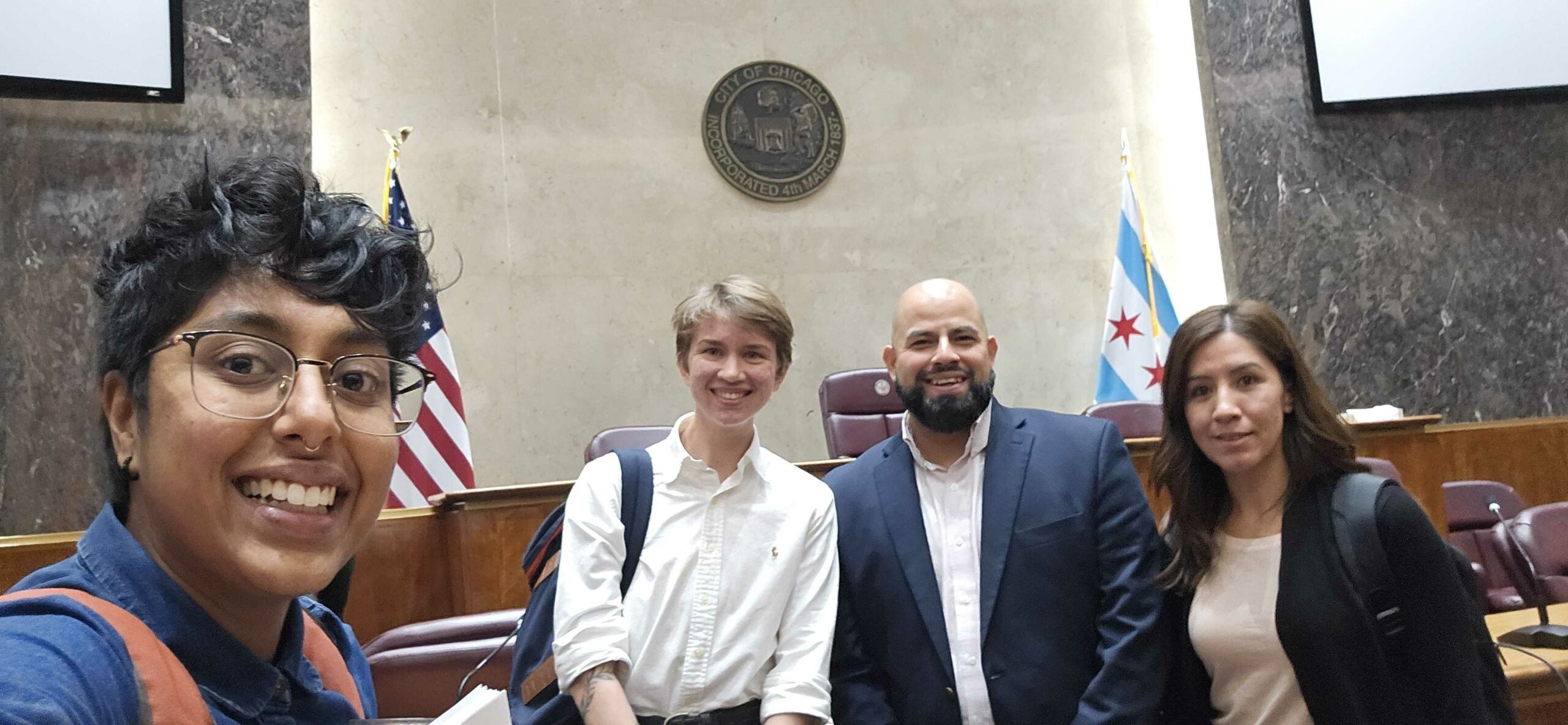
In May of 2023, Alderperson Vasquez was appointed as Chair of the Committee on Immigrant and Refugee Rights (CIRR), and what a year it has been!
-
Today SO2024-0008386, which I introduced in March, passed the full City Council and was adopted into law. This ordinance directs the Department of Family and Support Services (DFSS) to provide City Council daily reports of…
-
As first 60 Day Shelter Eviction Policy deadline approaches on March 16th, the Mayor’s Office risks cutting against Chicago’s values and severely harming new arrivals.
-
Current newly arrived neighbor headcount at our 20th Police Station is 36! Our team of volunteers has worked tirelessly and your help is still needed. From financial contributions for specific needs to breakfast assistance or…
Contact the 40th Ward Office
Our office works to ensure you feel supported, connected, and valued. Please reach out with any questions or concerns you may have—we are here to help!