
On Tuesday, November 10th, the Committee on Immigrant and Refugee Rights hosted a virtual Immigration Briefing with our community partners to cover the most recent updates in immigration.
As always, none of the below should be considered legal advice! The federal policy and legal landscape around immigration is changing rapidly, so any of the information below may soon be out of date. If you’re concerned that any of these updates may impact you, we recommend getting an immigration screening from an attorney. Visit illinoisimmigrationinfo.org/legal to get connected with legal support.
Good News
Last week, we saw a tidal shift in Congress, with Democrats taking control of both the House and the Senate. This shift represents a clear mandate against—among other things—the cruel immigration enforcement practices of the Trump administration, and the new Congress is already signaling that changes to immigration policies will be among their first priorities.
Immigration groups from across the country wrote a letter urging lawmakers to prioritize a robust campaign of immigration reform and oversight, with demands including:
- Ending ICE detention
- Clawback of funding to ICE and redirecting those tax dollars to community needs (e.g. healthcare)
- Ending DHS use of warrantless arrest practices
- Protection of due process rights for immigrants
- Providing robust oversight and holding the administration accountable for their abuses and violations of due process in their campaign of immigration enforcement
As we navigate the next two years, the power of stories from immigration enforcement will be crucial. Here are some examples of current efforts to that end:
- The People’s Record: A Report on the People’s Hearing on Immigration Enforcement: Chicago: This report documents how federal immigration enforcement has shaped civil rights, constitutional protections, and daily life across Chicago and Cook County, based on the testimony of those impacted and legal experts. It also outlines the community’s recommendations for oversight, accountability, and stronger protections for immigrant communities citywide.
- Disappeared in America features nearly 500 entries documenting people who have been detained, deported, separated from their families, killed or otherwise impacted by federal immigration enforcement. It also features the work of the Illinois Accountability Commission, which was established after Operation Midway Blitz, and will continue to document as new cases emerge.
For more on the impact of mid-term elections, check out NIJC’s post-election briefing on December 9th. Follow @immigrantjustice to be alerted once event details are finalized.
Litigation Updates
Several organizations have filed lawsuits against the government for its actions related to immigration enforcement, including:
- FTCA Claim for Silverio Villegas Gonzalez: NIJC and the MacArthur Justice Center filed an administrative complaint against DHS, ICE, and the FBI through the Federal Tort Claims Act (FTCA) for the unjust, violent, and unlawful killing of Silverio Villegas Gonzalez.
- Greater Boston Legal Services et. al. v. Mullin: Challenges the Trump administration’s policy of hiding the locations of people detained by ICE. In September, thousands of people went missing from the ICE locator site, due to a new policy where DHS hid the locations of anyone with final removal orders. This lawsuit argues that the policy is a violation of first amendment rights, and has asked for a stay to require ICE to continue providing location data while the case is ongoing.
In other litigation updates, last year, DHS broke with decades of precedent to determine that non-citizens who have not been admitted into the U.S. are not entitled to any due process rights. The 5th Circuit upheld the policy that an unadmitted noncitizen has no statutory or constitutional right to a bond hearing. The Supreme Court will likely need to decide ultimately whether this policy is lawful. In the meantime, here are few things to keep in mind:
- This decision does not apply to people who were admitted, and it does not apply outside of the 5th Circuit (Louisiana, Mississippi, and Texas).
- It’s important to file habeas petitions as quickly as possible before transfer to 5th Circuit detention centers.
Federal Policy Updates
Asylum
Access to asylum has been severely limited over the past decade, but especially under this administration, which has made it much more difficult to apply and be granted asylum. Asylum seekers have been subject to greater restrictions, the government is regularly bypassing traditional interviews to limit asylum seekers from providing testimony in support of their asylum claims, and there has been an increase in denials as a result.
While it is still possible to apply for asylum, here are some of the recent changes making asylum more difficult:
- USCIS is no longer required to issue Requests for Evidence if an application is missing evidence. That means they can now outright deny benefit applications without giving applicants an opportunity to provide additional evidence.
- An interim final rule permits USCIS to refer applicants directly to immigration courts without first holding a non-adversarial asylum interview. This rule applies to new and pending asylum applications. For applicants who have been waiting years for an asylum interview, this means that they may receive a notice to appear in immigration court and placement in removal proceedings instead of an asylum interview.
- Asylum seekers having court dates moved without notice resulting in increased removal orders in absentia. Attorneys recommend that asylum seekers with cases pending should frequently check their case information regularly, as asylum seekers are having court dates moved without notice, resulting in increased removal orders in absentia.
- USCIS Annual Asylum Fee: Asylum seekers are still subject to paying a $100 fee to apply for asylum, but guidance on how to pay is still unclear.
The backlog at USCIS has also worsened, as a result of an order that halted the adjudication of all pending asylum applications, regardless of nationality or type of claim. A federal judge ordered the government to restart processing of asylum applications, but we continue to see major backlogs. All of these policies represent a huge violation of due process for asylum seekers.
The Board of Immigration Appeals is also reshaping enforcement through decisions that make it significantly harder to qualify for asylum, overrule established precedents, or rewrite asylum standards to the administration’s campaign of mass deportation. Here are some of those recent decisions:
- Matter of GRB: This case authorizes immigration judges to dismiss asylum applications on their own initiative without a formal motion from DHS.
- Third country removals
- The BIA ruled that immigration judges generally do not need to hold live evidentiary hearings for asylum cooperative agreements, thus restricting due process and accelerating removals.
- The BIA also held that an immigration judge cannot find an applicant credible if the applicant amends information at a later date without adequate and convincing explanation for why the information was not provided in the first place.
In slightly better news, a federal court issued a temporary restraining order regarding a USCIS policy that fast-tracks unaccompanied children’s asylum cases. The federal government has been giving children extremely short notice on their asylum interviews. This case reinstates a 21-day notice period for interviews, and we anticipate an update on this litigation later this month.
Immigration attorneys recommend that asylum seekers seek assistance at the Help Desk in Immigration Court. You can call or text the hotline at (312) 660-1328 to receive a consultation.
Deferred Action for Labor Enforcement (DALE)
DALE Program protected non-citizen workers from deportation and provided work permits. The Trump administration has ended this program and are no longer processing applications or renewals. DALE permits generally remain valid until their expiration. Anyone whose status is or has expired should contact an immigration attorney to screen for other types of immigration assistance.
Temporary Protected Status
Temporary Protected Status (TPS) for three more countries has now been announced:
- El Salvador: pending termination, as the formal termination was not done properly. Work permits and protections remain valid as of this date.
- Sudan: ended October 19, 2026
- Ukraine: ended October 19, 2026
- Lebanon: remains valid until November 27, 2026
State Updates
Secretary of State Updates
The Illinois Secretary of State’s office now allows anyone with a valid foreign passport and a 12-month Illinois residency to apply for a Non-visa Driver’s License, as opposed to the older Temporary Visitor Driver’s License (TVDL), which was marked as being not valid for identification.
These policies were implemented to address the fact that many people are subject to increasing USCIS backlogs, and ensuring that people are still able to access a standard driver’s license. Learn more about how to apply at the ILSOS website.
Delays on renewals and work permits are also impacting DACA recipients’ Real IDs, if they do not receive their renewal before their REAL ID expires. If that happens to you, you can apply for a standard driver’s license, and you can find the Illinois Secretary of State guidance for DACA recipients impacted by renewal delays at 40thward.org/StateofDACA.
City Updates
Food Vendor Licenses
As part of the City budget process, the Mayor’s Office has introduced legislation that proposes a new food vendor license category: Mobile Food Cart Preparer (MFCP). The license includes the following provisions:
- Those with this license would be allowed to prepare and serve unpackaged food on residential streets outside 2-5am, though the license includes a 4-hour limit in any one block
- Food vendors would still be disallowed in vendor prohibition districts like Millenium Park, and anywhere within 200 feet of any business selling food, except from 12am-2am. They would also be allowed on private property with an agreement, but not vacant property
- The new license also allows government officials to create zones where food carts are allowed, even if restaurants are near.
- The license requires a hand sink, which may be portable and equipment to ensure adequate hot and cold holding to maintain TCS foods
An interactive map of proposed exclusion zones can be found here.
Calls to Action
There are several opportunities this month to make your voice heard by your city and federal representatives, and to support immigrants and refugees in our city!
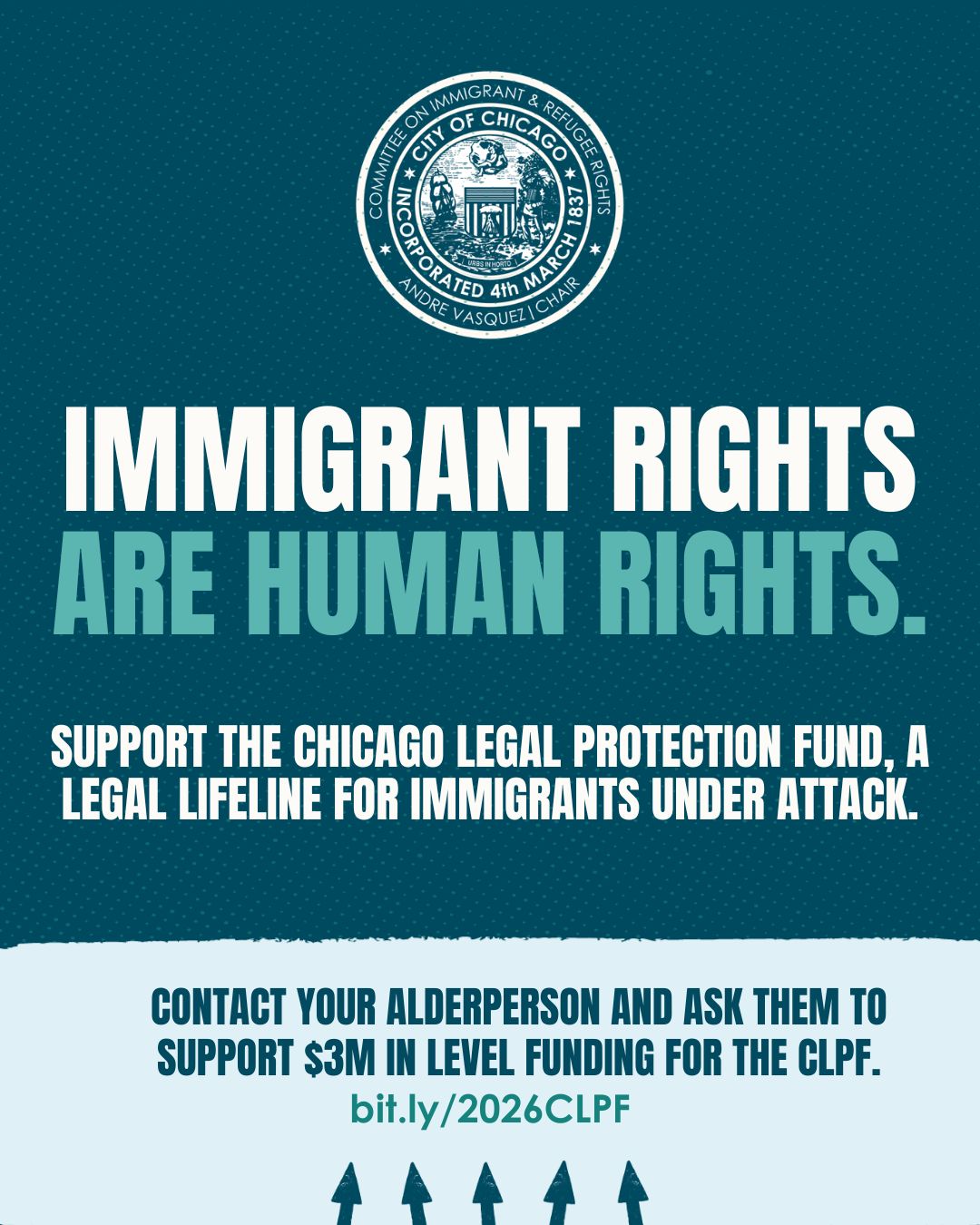
- Protect access to legal representation:
- Fund deportation defense and expand the Immigration Division in the Cook County Public Defender’s Office:
- Ask Your Congressional Reps to Support the American Dream & Promise Act Discharge Petition
- On July 20, 2026, Representative Sylvia García (D-TX-29) filed a discharge petition that aims to force consideration of the American Dream and Promise Act (H.R. 1589).
- This bill was introduced by Rep. García on February 26, 2025 and combines two initiatives that create a pathway to regularization for Dreamers and DACA, TPS, and DED beneficiaries.
- They are currently at 217 signatures. Find and contact your Member of Congress here to make sure they sign on!
- Stop additional funding for mass detention and deportation
- On September 1, 2026, the House passed a Continuing Resolution funding the government through December 11, 2026.
- Tell your Congressperson: Not One More Dollar for ICE and Border Patrol
- Volunteer for Court Accompaniment
- ICE has been active outside courthouses, in defiance of Illinois State law. If you’d like to volunteer to accompany individuals and families to their court appearances, submit a volunteer interest form with the Sanctuary Working Group.
- Shop Local: Chicago Loves Local is a free campaign to promote local shopping, available in all 77 community areas of Chicago, aimed at boosting and supporting the local businesses that shape the vibrant neighborhoods of our city. Here’s how you can support:
Lastly, we encourage those who attended our briefings this year to fill out our 2026 Survey and tell us what you’d like to see from these briefings next year!
For more on how you can support immigrants and refugees in our communities, visit the CIRR Protecting Immigrant Rights page and Illinois Immigration Info to find out how you can get more involved.
The next immigration briefing will be on Tuesday, December 8th at 1pm! Register at bit.ly/CIRRBriefing.